
Text by Vittoria Martinotti
Through mud, we catch a glimpse of a world whose forms are still open to one another. Earth, maternal liquid and resin, Ivy Chilelli brings the organic and the artificial into the same imagined substance. An edge can soften where it touches another, a fibre can slip across that softened fragment, take hold and grow there. What becomes possible at that point of contact, when each begins to change in ways it never could have on its own?
This is the genesis Chilelli imagines and longs for. In the cosmos she conjures, a body takes shape through its encounters and remains open to whoever or whatever it might meet next. Every transformation begins as an act of imagination, a chance to inhabit a form that did not seem possible before. The creatures that emerge from these encounters are the ones the artist gathers, one by one, into her unfolding bestiary. They have the air of relics from a future we might still bring about, or fragments of a long-lost world. In their folds and cavities, care and protection take on an anatomy of their own. An inward sweep can be the place where one creature has made room for another.
The forms Chilelli creates reject the violence of separation. They inhabit a threshold where identities remain porous and transformation is welcomed. Their political dimension lies precisely in this constant openness to change. The queer body is not presented as an exception or metaphor, but as a condition of existence itself, unfinished, self-determined and perpetually capable of exceeding the boundaries imposed upon it. Chilelli explores that possibility through an antispeciesist lens. In her sculptures, a fibre, a fragment of coral or a strip of metal can determine how a creature takes shape and whether it holds together. The hierarchy that places human life above all other forms gives way to an ethics of coexistence. Survival is a practice grounded in relationships, and the passage from a singular form to a collective body changes what each of its parts can do.
With MUD AND OTHERKIND, Chilelli lends a vertical dimension to this proposition. The two floors of the gallery lie one above the other like layers of sediment. Matter rises into imagined organisms, hangs in suspension, sends out roots and threads, then comes apart again. Above, disparate forms graft and hold. Below, their contours loosen and the possibility of another arrangement opens.
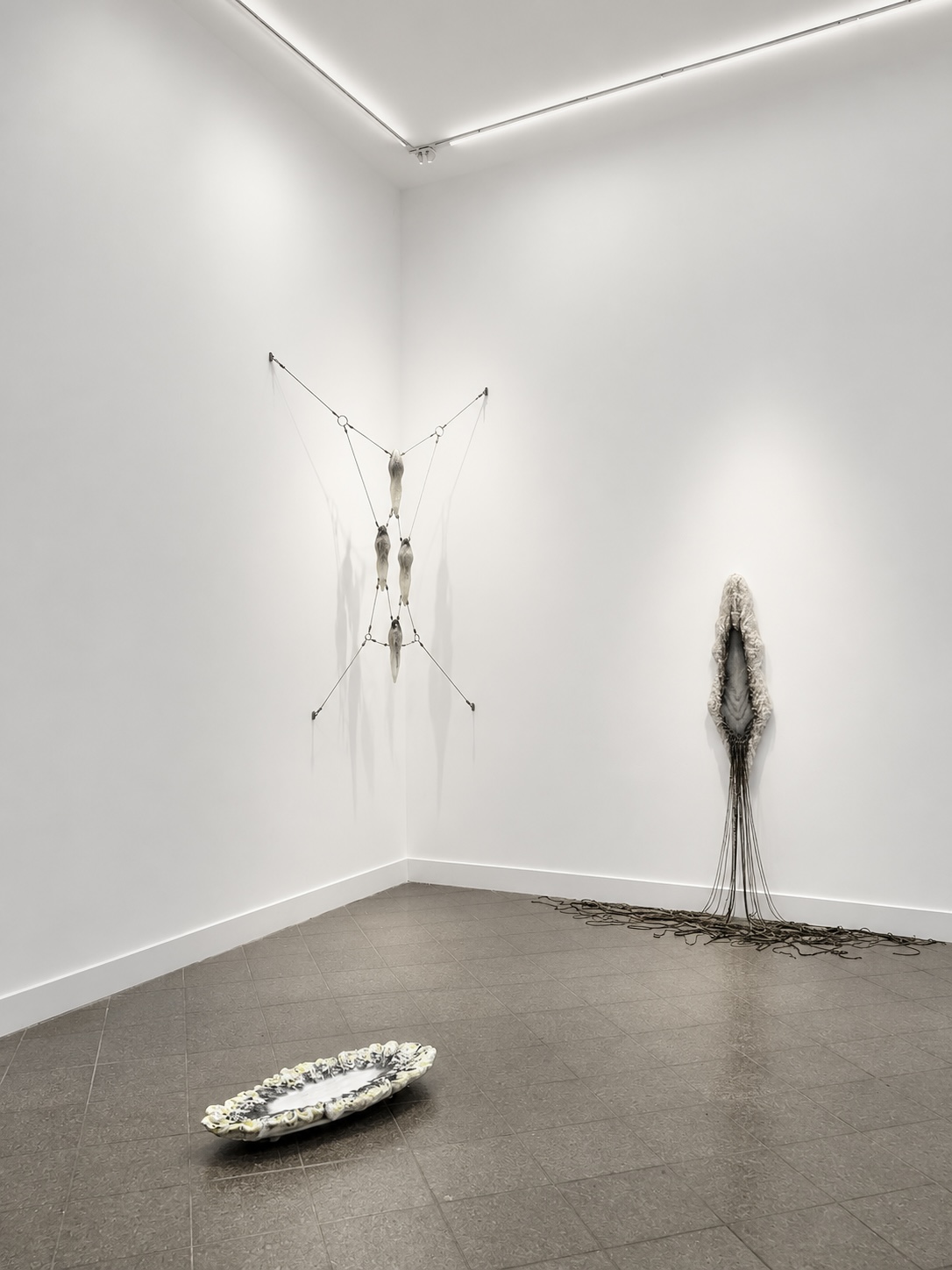
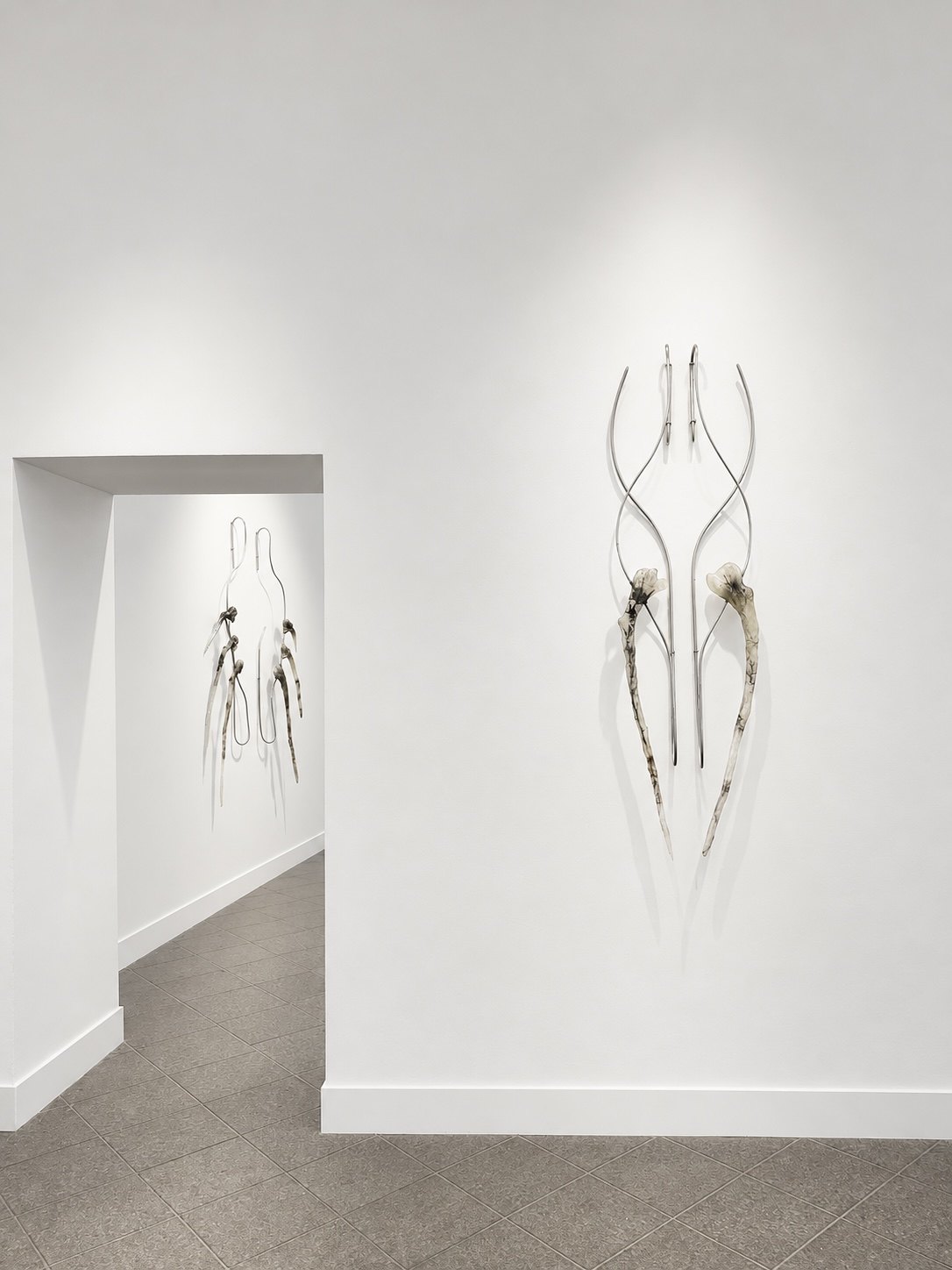
ORIGIN MUD holds the exhibition’s genesis in a shallow pool. Within a glazed ceramic rim, a pearlescent liquid takes on the colour of whatever light reaches it. That lustre returns in the resin bodies suspended above us. It is the one feature they seem to have inherited from the same source, though what each has gathered into itself differs. Plant matter, fabric and metal enter into compositions that could still shift, even after the resin has set.
The sheen at our feet draws our gaze upwards, towards suspended bodies. CORPS NOUVEAU and SHELTER, give this composite anatomy the span of two rooms. In the first, resin ribs project from aluminium, in the second, an elongated silhouette unfurls overhead, picking up the rhythm of the ribs at a distance. A chest begins to suggest itself around us, its parts held apart by the very space we occupy. In the corner inhabited by HOLD MY FALL, that relation takes a more precarious form. Four small resin bodies share their weight, though each keeps its own outline. The points at which they support one another are easy to overlook, and the work depends on precisely those points. There is a certain reserve to this form of care, a way of being indispensable to one another without having to draw any closer.
Some of the creatures we encounter upstairs reappear on paper. The two prints of UNBORN BESTIARY read like pages from a rediscovered herbarium, a first attempt to catalogue the inhabitants of Chilelli’s imagined cosmos. In SHELL II, what extends beyond the body is a set of threads. They slip out of the resin and trail down the wall. After so much looking up, our gaze follows their fall. At the stairs, we begin to descend towards the matter from which these organisms first took shape.
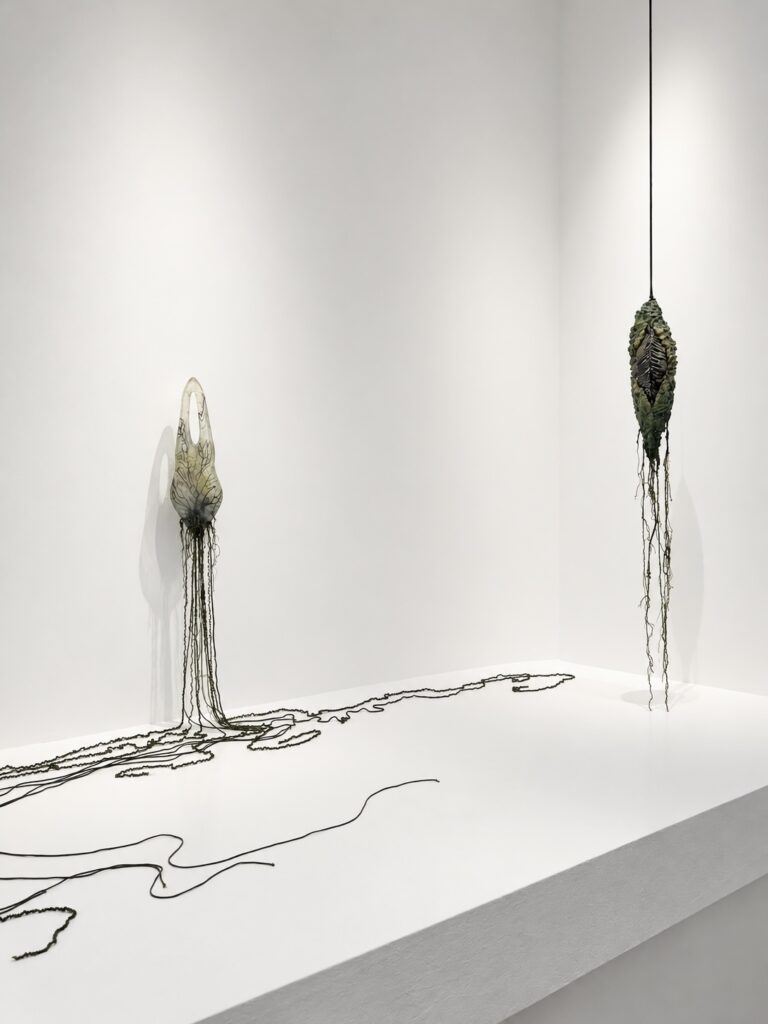
Below, the light thins. A low bubbling swells and recedes in the soundscape Chilelli created with DJ and producer JOA. What we first looked down into now seems to surround us. As our eyes adjust, flowers, small organisms and what might be the remnants of a skeleton come into view among the ceramics, including works from IN FLESH, YOU’RE GONE and EXUVIAE. Some surfaces appear to have crystallised over an immense stretch of time. Others have the look of things only recently separated. The mud holds both possibilities close. What has come loose from one body is available to another.
Between elevation and descent, crystallisation and dissolution, Chilelli constructs a cosmology in which fragility is the very condition that makes strength possible. Her sculptures ask what bodies might become in one another’s presence, how they might sustain one another without relying on resemblance. In her work, becoming matters more than being. Each being remains joyfully unfinished, open to contamination, encounter and the possibility that what we call foreign may already be taking shape within us.
Available artworks